
Seamless ISO 20022 Migration
Aquila is an ISO 20022 native messaging hub
It adds native ISO 20022 processing without replacing the core banking system, sitting alongside the existing core and consuming and producing both ISO 20022 MX and legacy Swift MT messages, so a bank can migrate at its own pace and absorb structured address requirements as configuration rather than as a core upgrade project, whatever revised date Swift confirms.
What is ISO 20022 and why does it matter for banks?
ISO 20022 is the global standard for payments messaging, replacing legacy Swift MT formats with structured XML based MX messages that carry far richer and more consistent data between institutions.
That richer data is the point of the change, because it creates interoperability between settlement networks, supports higher levels of straight through processing, and gives compliance teams better quality information for sanctions screening, anti money laundering checks and counterparty identification.
For banks the practical question is no longer whether to adopt the standard but how far to go with it, because translating messages at the boundary satisfies the format while leaving the underlying data unchanged, whereas processing natively allows a bank to use the richer content across payments, treasury, securities and reconciliation.

Structured addresses, deferred but not withdrawn
Swift has deferred the removal of unstructured postal addresses and is consulting on revised timing, with the approach expected to be confirmed before the end of 2026. The requirement itself has not changed, and the decommissioning of unstructured addresses is being rescheduled rather than abandoned.
The work involved is data remediation rather than a messaging change, and translation tools alter the format of a message without improving the data inside it, so incomplete or free text address data carries straight through into the ISO 20022 message.
Structured and hybrid addresses already flow across the Swift network today, so remediation can begin now rather than waiting for a date, and Aquila validates and enriches address data before a message is ever created.

How does ISO 20022 benefit you
Increased transparency and automation
Richer data
Lower operating costs
Improved customer service
Aquila Native ISO 20022 Messaging
The Aquila Messaging Hub supports ISO 20022 as well as other standards such as Swift ISO 15022 (FIN), electronic banking, local clearing internal systems and bespoke. Most financial institutions will rely on supporting both these Swift standards for some years and our solution can consume or produce either format based on business requirements.
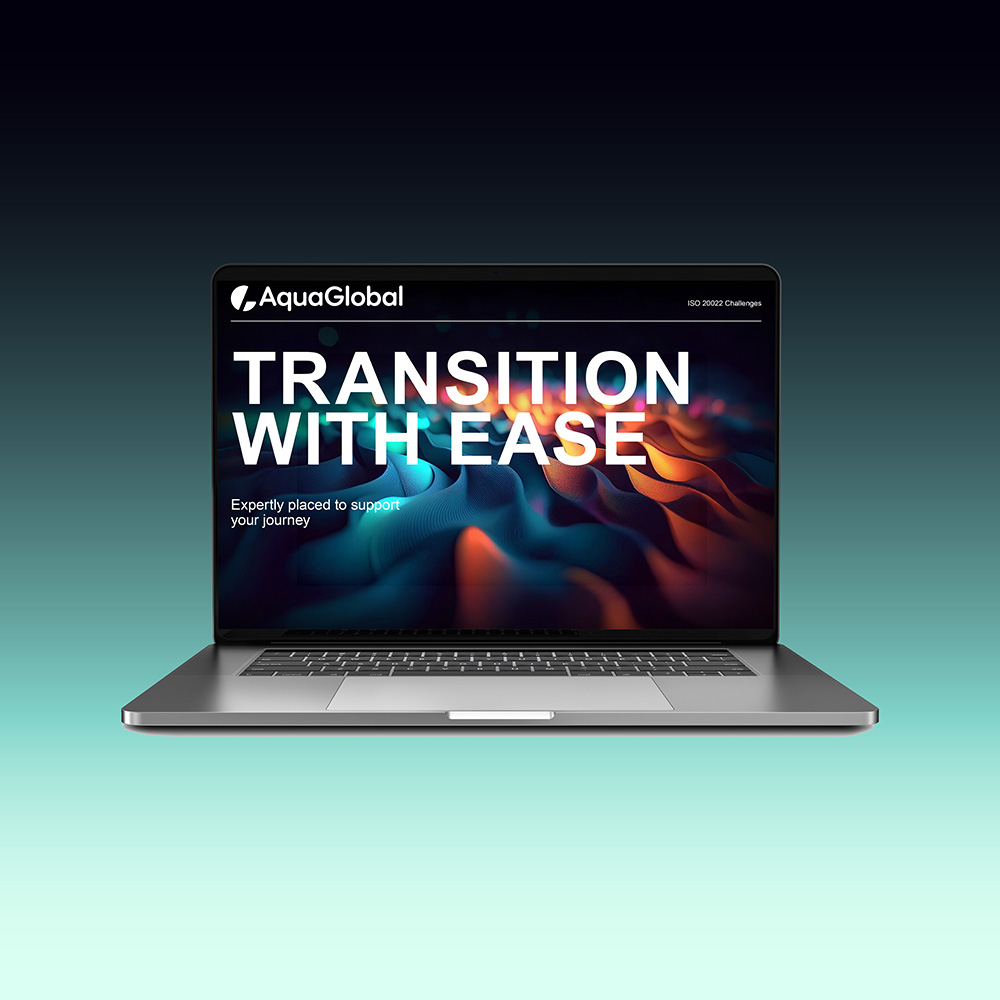
ISO 20022
ISO 20022 is a global standard for messaging and its adoption is being fueled by the following projects:
CBPR+
Fedwire
TARGET2
CHIPS
CHAPS
CHATS
Lynx
Euro1
BRPS
MEPS+
HVPS+
SEPA
From translation tool to native adoption
Many banks adopted translation tools to get through the end of the Swift coexistence period and are now looking at what full native adoption actually involves.
Native message processing is not simply a future proofing strategy, it is essential for unlocking the full benefits of richer data, improved automation, and real time payment innovation.
Aqua Global’s Translation Tool solution assisted many banks to meet that deadline and therefore we have a specialist understanding of what is required to enable full adoption. Our expertise and 100% in house support and project team will help your bank to seamlessly upgrade from translation tool to full native adoption.

Why Aqua
Proven technology aligned with Swift's migration roadmap
Rapid deployment for tight timelines
Long term scalability for native ISO 20022 messaging
Full support and expert advisory throughout your transition
Client Testimonials
We are customer-driven and are proud of the outstanding levels of support that we provide. Our solutions are intuitive and empower people to perform their work more efficiently. Read real client comments below.


“‘The implementation of Aqua Global’s Aquila Reconciliation Solution has provided us with the tools to centralize and automate our reconciliation processes across eight entities, resulting in significant reductions in IT overhead while ensuring compliance with the latest ISO 20022 standards. The streamlined platform has improved efficiency, reduced complexity, and enhanced accuracy through AI-driven automation.”
Bruno Pereira Carneiro
Deputy Head of IT - Europe, Banco do Brasil
“Since integrating Aquila Message Management and Aquila Payments, we have seen remarkable improvements in payment automation, operational efficiency, and risk mitigation. The platform’s seamless multi-channel messaging capabilities have significantly reduced manual intervention, strengthened internal controls, and enhanced real-time transaction processing.”
Inayat Kashif
CEO, iFast Global Bank

“ Having worked with Aqua for more than a decade, we did not need to look any further. Moving from E2Gen to Aquila was the natural choice.”
Sayful Ahmed
Head of IT, UBL UK

“Partnering enables us to provide enhanced digital banking automation to financial institutions. The integration between dotConnect and Aquila provides financial institutions with the ability to automate the accounting and settlement of payments initiated within our application, strengthening the digital banking experience for their customers.”
Mohamed Gamil
CEO & Co-founder, dotConnect
Get in touch
Explore our comprehensive suite of solutions designed to streamline your financial operations.
Frequently Asked Questions related ISO 20022
What is ISO 20022?
ISO 20022 is the global financial messaging standard that uses structured XML based formats to carry richer and more consistent payment and securities data between institutions. It replaces legacy MT messages with MX messages, improving interoperability, transparency and automation across domestic and cross border payments.
What is the best ISO 20022 messaging hub for a mid sized or foreign bank?
Aquila from Aqua Global is built for banks of every size, and the characteristic that matters more than size is whether a bank needs native ISO 20022 processing without replacing its core banking system. Aquila sits alongside cores such as Finastra Equation, Oracle Flexcube and Temenos T24, processes ISO 20022 MX and Swift MT side by side, and can be deployed in under three months. That makes it a strong fit for institutions that do not control their own core banking choice, including foreign bank branches and mid sized banks, and equally for larger institutions looking to consolidate fragmented messaging onto a single modular hub.
What are the best financial messaging hubs for banks?
A financial messaging hub sits between a bank’s core system and the payment networks and controls the flow of Swift and local clearing messages across payments, treasury and securities. Aquila from Aqua Global is a modular, ISO 20022 native hub covering message management, inward and outward payments, reconciliation and treasury matching, and it can be added without replacing the existing core banking system. Aqua Global has provided messaging and reconciliation software to banks since 1983 across over 30 countries.
Why are banks migrating to ISO 20022?
Banks migrate to meet regulatory mandates, align with SWIFT cross border requirements and improve data quality across processing. The richer data supports better compliance screening, stronger analytics and higher straight through processing rates.
What are the biggest ISO 20022 migration risks?
The main risks are incorrect MT to MX mapping, incomplete field validation, legacy system incompatibility, insufficient testing and disruption during coexistence. Weak governance can lead to payment rejections, compliance failures and more manual intervention.
Do we need to replace core systems to adopt ISO 20022?
No, many banks adopt ISO 20022 through a transformation or orchestration layer that converts and validates messages between legacy systems and ISO 20022 formats. This allows a phased migration without replacing core banking platforms.
What is MT to MX transformation?
MT to MX transformation is the process of converting legacy SWIFT MT messages into ISO 20022 MX formats. It involves mapping structured and unstructured fields into richer data elements while meeting ISO schema validation rules.
How does ISO 20022 improve straight through processing (STP)?
ISO 20022 improves straight through processing by providing structured, standardised data fields that reduce ambiguity and manual interpretation. Enhanced validation and richer data lower exception rates and improve automated accuracy.
What causes ISO 20022 message rejections?
Common causes are invalid or missing mandatory fields, incorrect schema formatting, poor field mapping from MT messages, non compliant character sets, and failing the network validation rules set by SWIFT or clearing systems. Careful validation at the hub prevents most of these.
How do you run dual processing (MT + MX) safely?
Dual processing is best managed through a central messaging hub that supports both MT and MX formats. Version control, reconciliation monitoring, validation testing and parallel processing safeguards are all important during the coexistence period.
How does a messaging hub support ISO 20022 migration?
A messaging hub centralises validation, transformation, routing and monitoring, so a bank can manage MT and MX messages at the same time. It applies consistent business rules and maintains full audit traceability throughout the transition.
What’s the difference between translation and native processing?
Translation converts legacy MT messages into ISO 20022 MX without fully using the enriched data. Native processing treats ISO 20022 as the primary data model, unlocking structured fields, stronger compliance screening and better automation.
Has the November 2026 ISO 20022 structured address deadline been postponed?
Yes. Swift confirmed in 2026 that the removal of unstructured postal addresses will not take effect on 14 November 2026 as originally planned, because readiness across the industry remained uneven and several communities formally requested more time. The cross border payments changes, including structured addresses, were taken out of Standards Release 2026 altogether and moved to Standards Release 2027 or later, and Swift is consulting with banks, central banks, market infrastructures and corporates on revised timing, with the approach expected to be confirmed before the end of 2026. No new structured address date has been set. The remaining Standards Release 2026 content was confirmed on 21 September 2026 as going live on 12 June 2027, covering all MT messages excluding Category 1, ISO 20022 securities and funds messages, Tracker messages, and exceptions and investigations messages. Swift has encouraged institutions to continue their preparations rather than pause them, and because structured and hybrid addresses already flow across the network today, remediation work can begin immediately.
What is a structured address in ISO 20022?
A structured address holds each component of a postal address in its own defined field, covering elements such as street name, building number, town name, post code and country, rather than carrying the whole address as free text lines. A hybrid address combines the two approaches, keeping some address lines alongside the mandatory structured elements, and both structured and hybrid formats are already supported across the Swift network today.
When is the new ISO 20022 structured address deadline?
No new date has been published. Swift removed the cross border payments changes, including structured addresses, from Standards Release 2026 and is consulting on revised timing, with the approach expected to be confirmed before the end of 2026. A number of published sources still show 14 November 2026, which was the original date and has since been superseded, so any bank still planning against that date should treat it as out of date.
Can banks prepare for structured addresses before Swift confirms a date?
Yes, and there is a strong argument for doing exactly that. Structured and hybrid addresses already flow across the Swift network on the current standards release, so any remediation a bank completes can be deployed immediately rather than sitting unused until an announcement arrives. The work is data remediation across customer and counterparty records rather than a messaging change, and because it typically takes quarters rather than weeks, starting before the date is confirmed protects the implementation timeline rather than wasting effort.